
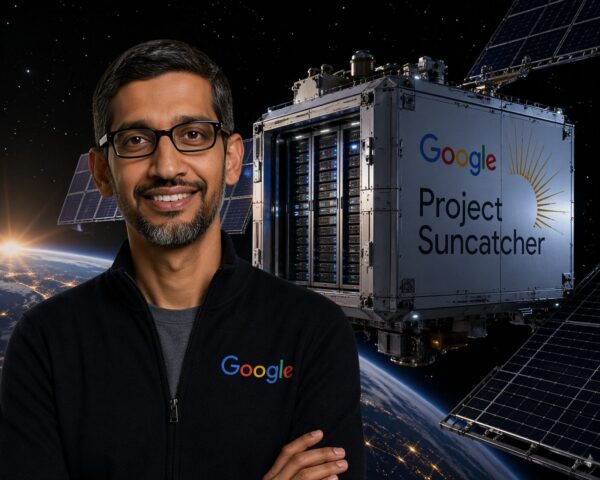
Project Suncatcher is an initiative by Google aimed at moving land data center into orbital data center amid massive land and energy shortages.
Table of Contents
The initiative was back stated in November 2025, when Google aimed at a long-term solution for the upcoming AI boom, and to tackle this, they have launched a web of satellite constellations of about 1 KM radius interlinking each other.
How Project Suncatcher works in Space
The following steps are taken as this Project keeps going ahead
1. The first number of satellites was placed in low Earth orbit (ranging from 400-650 KM above Earth’s surface)
2. Note that all the satellites are solar-powered so that they can operate for the long term
3. All the satellites are placed in a very close space, and they are interconnected
4. The satellites carry Tensor Processing Units (TPU)
5. The satellites enable the lesser communication setup as they transfer tons of data per second
What is Google Project Suncatcher’s aim?
Google Project Suncatcher aims to have an affordable space data center by using unlimited space energy sources and a low requirement of water.
The company have custom tensor Processing Units for machine workloads, and they have high-bandwidth free space optical links.
If this project is successful, then this can placed gigawatt level AI Compute cluster.
Google Project Suncatcher Challenge
The major Google Project Suncatcher challenge is to have a high launch cost per KG. The company will face direct challenge from Starcloud as they already tested a prototype much earlier in 2025, and expect Starcloud 2 will start operation if everything goes as planned.
The satellites that have already been launched or are about to be launched can’t be upgraded. The TPU chip will be upgraded very frequently, but we can’t replace them as they are already placed. The ground data center chip can be replaced anytime to keep it up to date.
Even after completing their lifespan, they need to re entry into earth atmosphere. If we don’t do this, space debris is difficult to handle.
Space enthusiasts warned that the possibility of kessaler syndrome may occur.
Today, the cost of sending an object in space is $3600/kg after the successful use of Falcon 9 reusable rocket.
The cost that makes a space data centre feasible is $200/kg.
This launching cost can be achieved around 2030. To date, most of the companies with an interest in this technology are eager to strengthen their hardware part.
Project Suncatcher Prototype
The Project Suncatcher Prototype is expected to launch in early 2027, and for that, they have partnered with Planet Labs. The prototype will test hardware as well as software parts that work ordo not. The major obstacle is radiation in space that has the potential to temper Tensor Processing Units (TPU).
Conclusion
Project Suncatcher of Google is an initiative through which a cluster of satellites, which contains Tensor Processing Units (TPU), with software capability for communication. Note that these satellites are placed near each other and process data. This project is expected to be launched in early 2027 with the hope to achieve orbitial data centre in reality.
What is Project Suncatcher?
It is a Google “moonshot” initiative to move land-based AI data centers into orbital satellite constellations to solve land and energy shortages.
Why did Google launch this initiative in November 2025?
It was created as a long-term solution to meet the massive infrastructure and energy demands of the ongoing AI boom.
How are these orbital data centers powered?
Every satellite in the constellation is solar-powered to ensure long-term, sustainable operation using unlimited space energy.
What specific hardware handles the AI workloads in space?
The satellites carry Google’s custom-designed Tensor Processing Units (TPU) specifically optimised for machine learning.
How do the satellites communicate with each other?
They use high-bandwidth, free-space optical interlinks to transfer tons of data per second within a 1 KM radius.
When is the first Project Suncatcher prototype expected to launch?
Google aims to launch the prototype in early 2027 in partnership with Planet Labs.
What is the primary environmental benefit of this project?
It eliminates the need for the massive amounts of water and terrestrial electricity required to cool and power Earth-based data centers.
What is the biggest economic obstacle facing the project?
The current launch cost of $3,600/kg must drop to $200/kg to make space-based data centers financially feasible.
What is the major hardware limitation of these satellites?
Unlike ground data centers, the TPU chips cannot be upgraded or replaced once the satellites have been launched into orbit.
How does Google plan to manage space debris and the “Kessler Syndrome”?
At the end of their lifespan, satellites are designed to re-enter Earth’s atmosphere to prevent the accumulation of dangerous space junk.

HEY! I Am Space Enthusitic person who tries to cover new technology like Data Center in space. Updated content helps you to keep updated on time.