
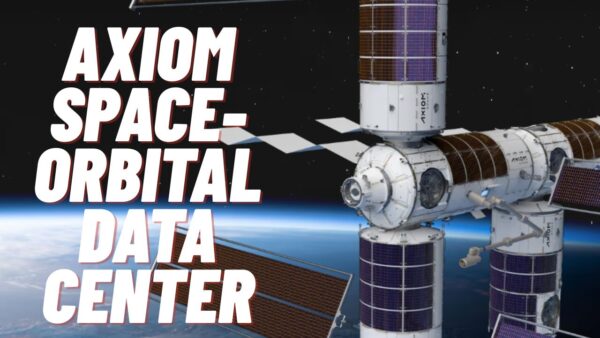
Axiom Space Orbital Data Center is a futuristic concept that they have been working on for a long time. The company started with AWS to see practical feasibility and is now planning to operate a space data center by 2027.
Table of Contents
Axiom Space — Orbital Data Center key Timeline
Year 2022
The company is looking for patner which can help them send small devices to a space data centre, and for that, they have partnered with AWS( Amazon Web Services). This device is small in size and installed on the International Space Station. This small Pandora box can stabilise the connection with the node.
Year 2023
Axiom Space gets its on hand experience with AWS’s smallest edge snow device. In late 2023, they announced that the first full module aboard Axiom Station will launch by 2027 and will provide AI compute data to Earth. For this node, they have partnered with Kepler and the Skyloom company, and its size will be a half-cubic-meter rack.
For connectivity, Skyloom is providing one Space Development Agency (SDA) Tranche 1-compatible commercial OCT, enabling up to 2.5 Gbps of connectivity between satellites in Low Earth Observation. This company will provide 100 Gbps connectivity between two nodes. The processed data will be sent to Earth with minimum latency.
Year 2025
In March 2025, Axiom Space – Orbital Data Centre partnered with Red Hat to power AxDCU-1 with their device. The software has the capacity to generate and store images and can be updated with Greenboot auto-rollback
Orchestration.
The unit uses MicroShift — a lightweight Kubernetes distribution — to run containerised workloads in space, and, most importantly, it works independently. This lightweight Kubernetes runs containerised workloads with the CRI-O runtime.
In a space data center, the most important thing is to have good connectivity between two nodes and be able to establish a connection with earth stations. This Red Hat automation system will onboard deployment, and it can operate thousands of devices at a single time. It can update the information, like app lifecycle, etc.
In April 2025, the company announced that they will launch two low-Earth orbit satellites by the end of this year, and these nodes will use the Kepler communication satellite system. By the end of this year, AxDCU-1 will be demonstrating cloud computing, AI/ML, data fusion, and space cybersecurity capabilities in orbit. The system operated autonomously on the International Space Station during communication blackouts with Earth.
Year 2026
In January 2026, both the nodes are successfully operational from ISS, and kepler communications satellites are established. This is the world’s first operational commercial orbital data center and it is placed in low-earth orbit.
Axiom Space Future Plan
Till 2027, the company plans to send a node to ISS and later work as Axiom Station modules. This center rack will as same size modules that were sent earlier.
Till 2030, the Axiom Space company plans to change modules and will be separated from ISS so they can operate individually. The growing demand for data center on earth came with lots of challenges as they require lots of energy, and real estate prices have skyrocketed. This station will be helpful for further lunar and Mars use cases, where data will be processed to check the feasibility of developement beyound earth atmosphere.
Axiom Space Orbital data Center Use
- Orbital AI – This will be the world’s first commercial data center where data will be process in earth and real-time interference, or an answer will be generated. These data center will be able to run large language models and help space satellites acquire data.
- National Security – This is an important aspect in today’s time where we see data center are key prime targets. The West Asia crisis is an example where data center are targeted by an enemy country. The space data center will solve these problems. The Dissemination of multi-sensor data from national security satellites will provide stability and help in cybersecurity in space.
- These Axiom Space Orbital data center will help to monitor other space assets and reduce space threat detection and tracking.
- High-performance storage and processing for the upcoming Lunar and Mars missions.
- Most of the satellite data has a problem of having high latency, but by commencing these data center they will process the data in space itself. The filtered data will be sent back to Earth.
- Most of the territorial data center have used lots of water and are set up near a water body. This will increase the risk of natural disasters and threats to the data stored in it. The space data centre doesn’t need water as a coolant, as the Earth’s atmosphere works as a coolant.
- Weather data is collected via satellite or ground station. These ground stations first collect the data, then AI will process it and finally get an answer. While transferring data, latency occurs, and the final output takes more time. The Axion Space Orbital data center will reduce response time and also process data.
Axiom Space Orbital Data Center Challenge
- Cosmic Radiation– The outer Earth atmosphere is full of radiation, and this will damage the hardware part of the data center. The silicon COTS are used, and this hardware has not been tested yet.
- Thermal cycling – The Axiom space data centre module will be attached to the International Space Station. This ISS will keep moving earth every 45 minutes, and outer temperature will be changed from +120 C to -120 °C very frequently. This requires many functional changes to the outer layer of modules.
- Thermal Cooling – The territorial data center consumes lots of water, so now many companies like Axiom Space are starting to build data center in space. But the problem is that high temperature turns into low temperature very frequently, and this can damage the communication and normal functioning of center.
- The International Space Station has limited and window to attach these data center modules. This can turn into a white elephant in case of operation hits due to blackouts. The power-producing capacity of ISS is limited, so once these modules increase in number, they start consuming power from solar plates.
- Over time, the software, and especially the hardware, needs to be updated. This process will increase the maintenance bill.
- The weather pattern in space changes frequently, and this could be a threat to the space data center.
Conculsion
The orbital data center is a new-age technology with lots of challenges. Once these challenges are overcome, these data center will become the choice of every company as they are cost-effective in future. The Axiom Space Orbital data centre is the world’s first data centre to begin commercial operations. With that achievement, hopes are high, and we are entering into new space tech.

HEY! I Am Space Enthusitic person who tries to cover new technology like Data Center in space. Updated content helps you to keep updated on time.